Protocol Architecture (Petal Diagram)
The Petal Diagram is the central architectural reference for the Nitrolite Protocol. It maps how deposits, withdrawals, transfers, and app sessions interact with blockchains, all centered on a user's channel.
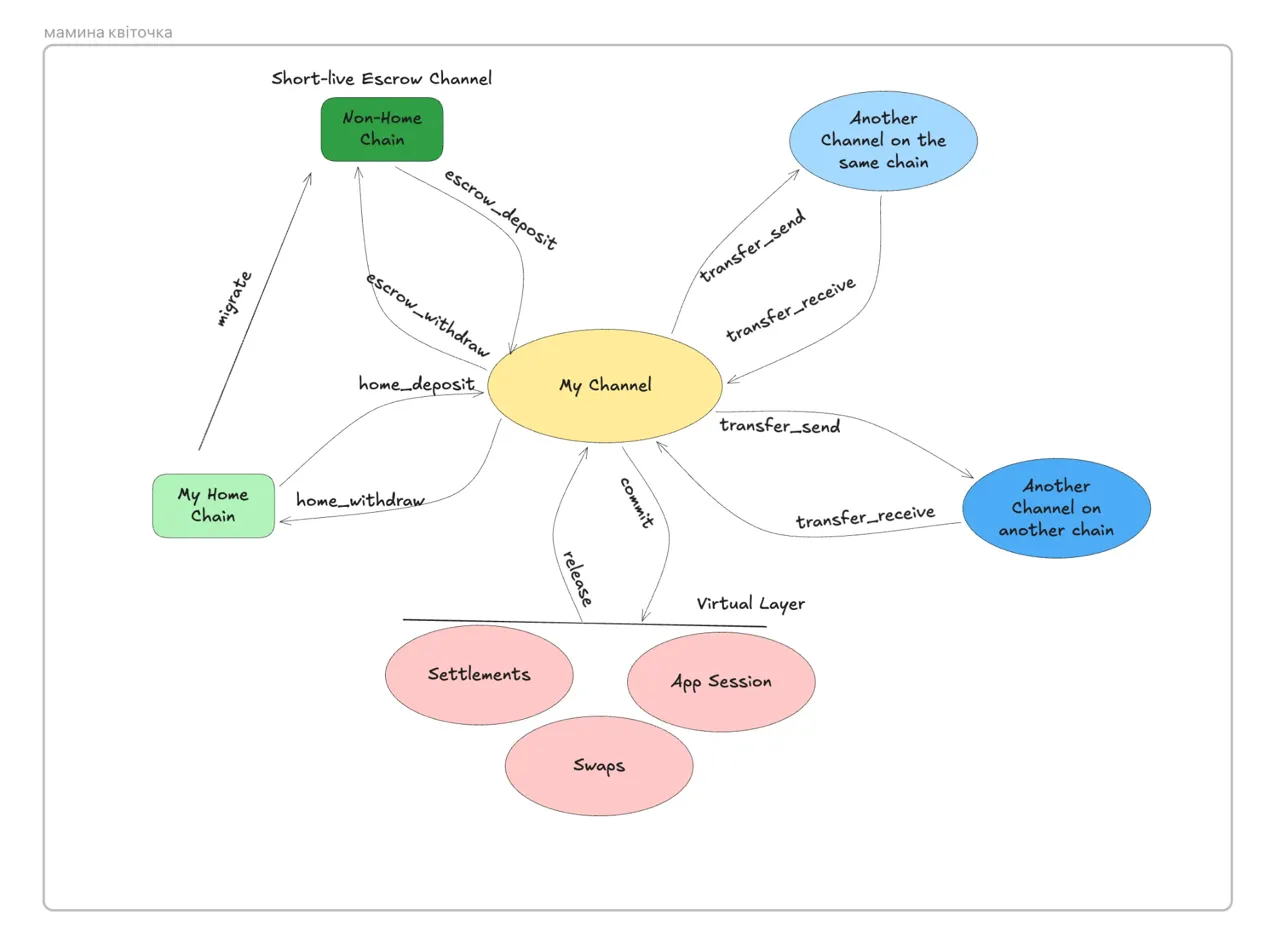
The diagram represents the architecture centered on a user's channel and maps how different actions interact with various blockchains.
The Four Petals
Petal 1: My Home Chain (Deposits and Withdrawals)
The Home Chain is the blockchain where the user's channel state is enforced for a specific asset.
:::info Important Choice When selecting your Home Chain, choose the blockchain where you are most comfortable depositing, enforcing and withdrawing a specific asset if cooperation with the Node fails. :::
The Flow: The user approves the ChannelHub spender, submits a signed home-deposit state, and ChannelHub pulls ERC-20 tokens or native ETH into the home channel. A home-withdrawal state releases funds from ChannelHub back to the user.
Petal 2: Another Chain (Cross-Chain Support)
When a user already has a Home Chain with funds and wants to deposit from a different chain, the protocol uses a two-phase escrow mechanism.
The Challenge: The home ledger is authoritative for enforcement, but the user's funds may start on a non-home chain.
The Solution: A signed escrow-deposit initiate state creates a non-home escrow record, and a signed finalize state completes the deposit and updates the home ledger. Cross-chain withdrawals mirror this flow. Token decimal normalization validates cross-chain amounts when token precisions differ.
Key Property: Escrow coordinates the home ledger and non-home ledger so cross-chain operations can be challenged or finalized according to the protocol rules.
Petal 3: Transfers (Sender and Receiver State)
Transfers update two unrelated user channels. The sender signs a transfer_send state. The receiver later acknowledges a Node-issued transfer_receive state.
The Solution: The sender signs a new state showing funds sent through the Node. Nitronode prepares a receive state for the receiver's channel. The receiver signs an acknowledgement to make the pending state mutually signed and enforceable.
Key Efficiency: Receive states can be batched before acknowledgement, reducing signature overhead while preserving the enforceable-state boundary.
Petal 4: App Sessions
App sessions are extension states funded by commit transitions from the user's home channel.
The Mechanism: A commit transition moves assets from the user's home channel ledger into the app session extension. The app session tracks its own state and participant allocations. A release transition returns assets from the app session back into the user's channel ledger.
Security and Risk:
- Home-channel assets outside app sessions remain recoverable through the latest mutually signed channel state.
- In-session app funds depend on the app-session participants and current extension-layer trust assumptions.
- The protocol roadmap includes stronger extension-layer enforcement and watchtower support.
:::note Current trust boundary App-session funds are not fully enforced on-chain in the current protocol version. Core channel assets remain recoverable through ChannelHub; extension-layer enforcement is still evolving. :::
UX Philosophy: Core deposits, withdrawals, transfers, and challenges stay tied to channel-state enforcement, while app sessions provide flexible application logic through the extension layer.