State and Ledger Model
States represent the current agreed configuration of protocol entities. The state model defines what information a state contains, how states are identified and versioned, and how states are represented for off-chain and on-chain use.
Common State Fields
All protocol states share:
| Field | Description |
|---|---|
EntityId | 32-byte unique identifier of the entity this state belongs to. |
Version | 64-bit unsigned integer, monotonically increasing. |
In addition to these common fields, each state contains entity-specific data defined by the respective entity specification.
State Identification and Versioning
Each state is identified by the combination of its entity identifier and version number.
Rules:
- The entity identifier is derived from the entity definition and is immutable.
- The version MUST start at 1 for the initial state.
- Versions are strictly increasing.
- Off-chain state advancement requires each new version to be exactly the previous version plus one.
- On-chain enforcement requires only that the submitted version be strictly greater than the currently recorded on-chain version.
Channel State
The channel state is the primary protocol state. It represents the current configuration of a channel.
| Field | Description |
|---|---|
ChannelId | 32-byte identifier derived from the channel definition. |
Metadata | 32-byte hash of channel metadata. |
Version | 64-bit unsigned integer state version. |
HomeLedger | Asset allocations on the home chain. |
NonHomeLedger | Asset allocations on the non-home chain. |
Transition | Operation that produced this state. |
UserSig | User signature for the state. |
NodeSig | Node signature for the state. |
The channel identifier encodes a protocol version byte as its first byte, followed by the hash of the channel definition parameters.
Ledger
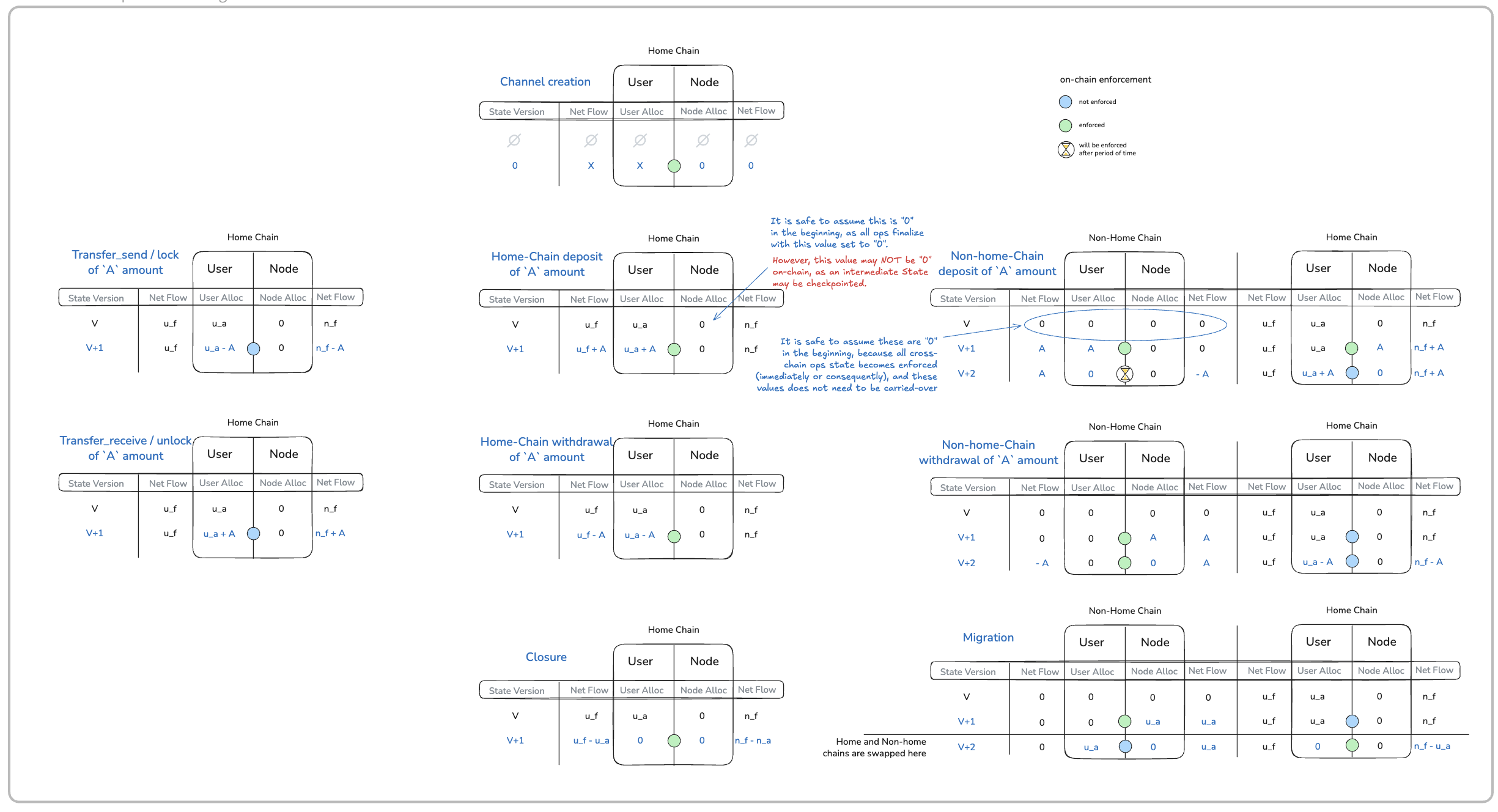
A ledger records asset allocations for a specific blockchain within a channel. Each channel state contains exactly two ledgers: a home ledger and a non-home ledger.
| Field | Description |
|---|---|
ChainId | Identifier of the blockchain this ledger is associated with. |
Token | Token contract address on this chain. |
Decimals | Decimal precision of the token on this chain. |
UserAllocation | Amount allocated to the User. |
UserNetFlow | Cumulative net flow for the User; MAY be negative. |
NodeAllocation | Amount allocated to the Node. |
NodeNetFlow | Cumulative net flow for the Node; MAY be negative. |
The ledger invariant MUST hold at all times:
UserAllocation + NodeAllocation == UserNetFlow + NodeNetFlow
All allocation values MUST be non-negative. Net flow values MAY be negative, reflecting outbound transfers or withdrawals that exceed inbound flows.
Empty Non-Home Ledger
When a channel state does not involve cross-chain operations, the non-home ledger MUST be empty.
| Field | Empty value |
|---|---|
ChainId | 0 |
Token | Zero address (0x0000...0000) |
Decimals | 0 |
UserAllocation | 0 |
UserNetFlow | 0 |
NodeAllocation | 0 |
NodeNetFlow | 0 |
An empty non-home ledger is structurally present but zeroed. A non-home ledger with metadata, such as non-zero ChainId or Token, but zero balances is NOT considered empty.
Off-Chain Representation
The off-chain representation is the primary operational format of a channel state. It is exchanged between participants during state advancement and is the representation that is signed.
The off-chain representation contains all channel state fields directly, including full transition data: type, transaction identifier, account identifier, and amount.
Enforcement Representation
The off-chain and enforcement representations depict the same logical state. The enforcement representation is derived deterministically from the off-chain representation.
Preserved fields:
- Version.
- Home and non-home ledger fields:
ChainId,Token,Decimals,UserAllocation,UserNetFlow,NodeAllocation,NodeNetFlow.
Derived fields:
- Intent: derived from transition type through the intent mapping table.
- MetadataHash: Keccak-256 hash of ABI-encoded transition data: type, transaction identifier, account identifier, and amount.
The enforcement representation is constructed as:
SignablePayload = AbiEncode(ChannelId, AbiEncode(Version, Intent, MetadataHash, HomeLedger, NonHomeLedger))
Because this mapping is deterministic, signatures over off-chain state are valid for enforcement and vice versa.
Intent Mapping
| On-chain intent | Protocol operation | Meaning |
|---|---|---|
OPERATE | transfer_send | Sender-side off-chain transfer. |
OPERATE | transfer_receive | Receiver-side off-chain transfer. |
OPERATE | commit | Move channel funds into an app session or extension. |
OPERATE | release | Return app-session or extension funds to the channel. |
OPERATE | acknowledgement | Acknowledge a Node-issued pending state. |
CLOSE | finalize | Finalize and close the channel. |
DEPOSIT | home_deposit | Deposit on the home chain. |
WITHDRAW | home_withdrawal | Withdraw on the home chain. |
INITIATE_ESCROW_DEPOSIT | initiate_escrow_deposit | Escrow deposit initiate. |
FINALIZE_ESCROW_DEPOSIT | finalize_escrow_deposit | Escrow deposit finalize or complete. |
INITIATE_ESCROW_WITHDRAWAL | initiate_escrow_withdrawal | Escrow withdrawal initiate. |
FINALIZE_ESCROW_WITHDRAWAL | finalize_escrow_withdrawal | Escrow withdrawal finalize or complete. |
INITIATE_MIGRATION | initiate_migration | Home-chain migration initiate. |
FINALIZE_MIGRATION | finalize_migration | Home-chain migration finalize. |
Transitions that map to OPERATE do not require on-chain enforcement under normal operation.
Escrow and migration operations are included for protocol accuracy. The protocol defines them, but the current Nitronode public app-builder workflow does not implement them yet.
Transition Field
Each state update includes a transition describing the operation that produced the new state.
| Field | Description |
|---|---|
Type | Transition type identifier. |
TxId | Transaction identifier hash. |
AccountId | Context-dependent account identifier; semantics vary by transition type. |
Amount | Amount involved in the transition. |
State Consistency Rules
State validity requirements differ between off-chain advancement and on-chain enforcement. In both contexts, these invariants MUST hold:
- The entity identifier MUST match the entity definition.
- The version MUST be strictly greater than the previously accepted version.
- Ledger invariants MUST be satisfied: allocations equal net flows, and allocation values are non-negative.